
World-leading clinical research showcased as Minister pays visit to NIHR Leeds Clinical Research Facility

An image of key clinical staff and colleagues standing smiling in a line up photo with Karin Smyth MP stood in the centre outside the NIHR Leeds Clinical Research Facility St James site.

World-leading clinical research and pioneering cancer treatment taking place in Leeds has been showcased as part of the Government’s national cancer plan roll out.  We recently welcomed Karin Smyth, Minister of State for Health to St James’s University Hospital to see first-hand the cutting edge cancer trials and the innovative treatment which is being pioneered. 
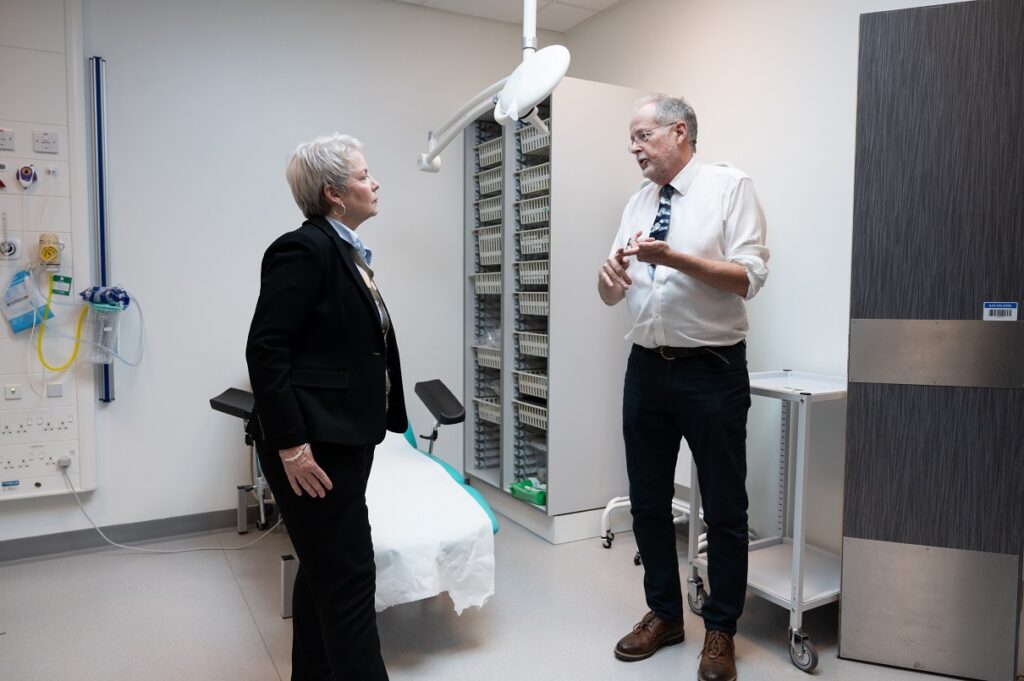
An image of Professor Chris Twelves speaking with minister Karin Smyth MP in a clinical room.

The Minister had the opportunity to meet with Prof Chris Twelves, Professor of Clinical Cancer Pharmacology & Oncology and Clinical Director NIHR Leeds Clinical Research Facility alongside clinical research colleagues, senior clinicians and experts and partners of Leeds Teaching Hospitals who work collaboratively to deliver world-class cancer treatment to patients across Yorkshire.    

Ms Smyth heard about the diverse and expansive portfolio of clinical research, particularly rare cancers including anal cancer, myeloma and sarcoma, while visiting the state-of-the-art NIHR Leeds Clinical Research Facility based at the hospital.  It was the opportunity for us to share the world-leading, early-phase, experimental medicine studies taking place right here which aim to develop new treatments and healthcare therapies for the future.  

Prof Chris Twelves said: 

“We were delighted to welcome Minister Smyth to NIHR Leeds CRF recently.  It was an opportunity to demonstrate our impressive track record of delivering early phase experimental medicine trials and evaluating a range of new therapies and interventions.   Leeds St James’s CRF is just one of our five clinical research facilities co-located at Leeds Teaching Hospitals NHS Trust  and it was a privilege for our team and I to talk about how we support world-class research here.”

An image of minister Karin Smyth MP with a health care professional standing talking in a hospital corridor.

The Minister also spent time in Leeds Cancer Centre, one of the most comprehensive cancer centres in the UK and home to the largest single-site radiotherapy treatment service.  It was the opportunity to shine a light on the advances in treatment of anal cancer using precision radiotherapy, which has been pioneered following research by Prof David Sebag-Montefiore, Professor of Clinical Oncology at University of Leeds and funded by Cancer Research UK.     We were delighted to share the breadth and depth of clinical research we do right here in Leeds and demonstrate the impact we’re having on our patients today and the healthcare of tomorrow.

Leeds heads multi-centre trial of innovative treatment for childhood Duchenne muscular dystrophy

An image of Edward with the care team at the NIHR Leeds CRF Children's site.

The NIHR Clinical Research Facility is playing a key role in a trial exploring a new treatment for children with Duchenne muscular dystrophy, a rare and progressive muscle-wasting condition.

The GUARDIAN trial, which is being run through NIHR Clinical Research Facility at Leeds Children’s Hospital, is evaluating the long-term use of vamorolone in Duchenne muscular dystrophy (DMD).

DMD is a genetic condition that usually affects boys. It causes progressive muscle weakness, with restricted mobility and a shorter life expectancy.

The newly approved treatment, vamorolone aims to help children with DMD maintain muscle strength for longer, whilst reducing some of the most difficult side effects associated with existing medications.

Current recommendations for care include use of anti-inflammatory drugs that supress a patient’s immune system, called corticosteroids. They can delay disease progression but often lead to stunted growth, emotional and behavioural challenges, and other quality-of-life issues that can be difficult to manage at home and at school.

Vamorolone is an alternative corticosteroid recently approved by the National Institute for Health and Care Excellence (NICE). In short term studies, it appears to offer the same benefits as current treatments, slowing decline in motor function but with fewer side effects related to growth, mood, and behaviour.

Dr Anne-Marie Childs, Consultant Paediatric Neurologist and Chief Investigator for GUARDIAN, said: “Having been one of the UK sites to take part in the original clinical trial of vamorolone (the Vision DMD study) we are pleased to see that vamorolone will be available for use in NHS care from April 2025. However, as with all new drugs there are many ‘unknowns’ with vamorolone’s use in clinical practice.

It is, therefore, essential to gather further data on its longer-term effectiveness and side effects which is why the GUARDIAN study is so important for both the UK and the international DMD community. We are delighted to be at the forefront of this work, as chief investigating UK site and the first to recruit to the study.” 

David Taylor and Rachel Allen’s son, Edward, aged 9, is taking part in the study. Living in Northallerton, North Yorkshire, Edward uses a powered chair daily to get to school and go on trips with friends and family due to his limited mobility.

“Our experience of being on a clinical trial has been fantastic. Regular check-ups with a kind and friendly team are great and he is being cared for brilliantly. It is amazing to think that being on a clinical trial allows Edward to help others in the same position in the future.”

David and Rachel said: “By using the powered chair, Edward then has the energy to use play equipment such as swings and slides – something which he loves. Edward is a remarkable, wonderful boy. In daily life we try to ensure that Duchenne does not ‘rule the roost’.”

They added: “Our experience of being on a clinical trial has been fantastic. Regular check-ups with a kind and friendly team are great and he is being cared for brilliantly. It is amazing to think that being on a clinical trial allows Edward to help others in the same position in the future.”

“The staff at Leeds are amazing and they go out of their way to ensure you receive the best care possible. We are really fortunate to live near such a great centre for research!”

Charity partnership backs neuromuscular research powered by NIHR Leeds CRF, enabling life-changing trials for families

An image of Austin in a hospital bed with him mother Maxine and Dr Anne-Marie Childs sitting at the side of the bed.

Duchenne UK and Leeds Hospitals Charity have partnered to fund two new roles within the Neuromuscular Service over the next five years. Together, they are contributing more than £300,000 to support this specialist team, recognising its status as a centre of excellence in paediatric neuromuscular research.

As part of the service, NIHR Leeds Clinical Research Facility (CRF) Children’s Site delivers pioneering clinical trials, exploring innovative treatments for neuromuscular conditions at Leeds Children’s Hospital and has consistently led the way in this area of research.

The NIHR Leeds CRF has been the first site in the UK to recruit to several clinical studies for Duchenne muscular dystrophy (DMD), the most common and severe form of childhood muscular dystrophy. Most recently, the children’s research unit delivered a landmark Phase 1 trial investigating a promising new treatment for DMD.

11-year-old Austin was diagnosed with the condition in November 2015, at just two years old. Austin’s mother Maxine initially thought he had a virus and took him to hospital, where he spent the next month having tests.

Three years ago, Austin began a trial at the NIHR Clinical Research Facility Children’s Site. Austin has received over 130 infusions, and though he knows he will lose the ability to walk, he tells Maxine he takes part in the trials because, ‘I want to help boys in the future to walk longer.’

For Austin’s family, the opportunity to participate in clinical trials has been a lifeline, offering hope to other families to find better treatments and eventually a cure. Austin’s current trial ends in September, but Maxine says if he chooses to continue to take part in research trials, they will continue to visit hospitals up and down the country.

‘From the moment Austin was diagnosed, our world changed. Nothing could have prepared me for the grief of knowing his life would be cut short. But through the darkness, clinical trials gave us hope. The support from the team in Leeds has been incredible; they’ve become like family. Research is vital, not just for medical breakthroughs, but for families like ours to feel less alone. Austin is paving the way, and we’re so proud of him.’

The funding from Duchenne UK and Leeds Hospital Charity will go towards funding the role of Consultant Paediatric Neurologist Dr Anne-Marie Childs. Dr Childs said the funding would be enable the service to plan for the future.

‘We’re incredibly grateful to both Leeds Hospitals Charity and Duchenne UK for their grant funding to support the children’s neuromuscular service. This investment will allow us to attract the best people to work in the Leeds neuromuscular team and create new opportunities for clinical trials that can support even more families. Neuromuscular conditions have a devastating impact, not just on the child affected but the whole family; funding like this gives hope that new treatments and new drugs can be developed.’

NIHR Leeds CRF at 20th UKCRF Network Conference

The NIHR Leeds CRF team standing on the steps at the conference.

NIHR Leeds CRF recently attended the 20th annual UKCRF Network Conference in Birmingham, the first to be held jointly with the NIHR Biomedical Research Centres.

Twenty-three of our team members, representing the broad scope of our work in clinical research, joined hundreds of delegates from across the UK to exchange insights and learn about the latest developments in healthcare research. It was an opportunity to create new connections and emphasised the importance of collaboration in delivering world-class research which is truly impactful.

Dr Helen Radford and Karl Ward delivered an outstanding session at the conference on the ever-growing role of artificial intelligence in advancing research. Dr Radford also shared valuable reflections into attracting commercial clinical research, and Karl Ward presented our approach for best practice in training and embedding research within NHS teams.

We were also privileged to hear from our patient and public involvement and engagement (PPIE) Manager Hanif Ismail and patient representative Barrow Sawo, who spoke compellingly about overcoming challenges in public engagement, highlighting inclusive strategies for meaningful collaboration.

The team had a great experience celebrating their successes at the conference, where they not only presented their research to peers but also had the opportunity to meet and exchange ideas with other leaders in clinical research delivery. Our thanks to the organisers, we are already looking forward to next year’s conference!